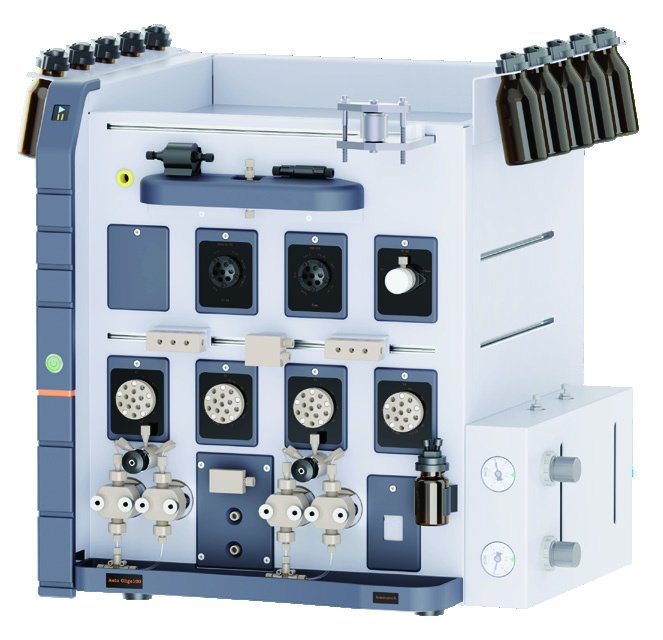
Downstream purification determines both the quality and the cost of biopharmaceuticals. We cover the entire scale-up path: Protein A, IEX, HIC and SEC resins; laboratory glass columns through to automated production columns; lab, pilot and process purification systems; TFF and biopumps; and continuous chromatography.


These are the criteria to look at when choosing a product for your application, and the information that is helpful to share when you contact us. Specifications and options list only what has been confirmed.


Over 20 years devoted to filtration — from sterilizing and virus filters to single-use assemblies
This brand's products in other process stages Filtration & Separation: Depth filtration · prefiltration, sterilizing filters, virus filtration · prefiltration, TFF cassettes · hollow fibers, air · gas · vent filtration, related equipment ›Single-Use & Fluid Management: Single-use bags · tubing · connectors · assemblies, sampling · filling · frozen storage ›

From lab protein purification to pilot and production — bioprocess equipment from one manufacturer

Dedicated to downstream purification equipment — from i-Axi® auto-packing columns to biopumps and TFF systems
This brand's products in other process stages Filtration & Separation: TFF · hollow fiber filtration systems ›

Over 100 chromatography resins — from Protein A to SEC, produced in batches of 1,000 L

Over 40 years devoted to chromatography — from analytical columns to process-scale purification
After a column is newly packed or has been in use for a long time, the packing is checked by passing a small amount of a tracer that does not bind to the resin and measuring the height equivalent to a theoretical plate (HETP) and asymmetry (As). This guide summarizes, based on public sources, the test method, the formulas, how to read the results, how to set acceptance criteria and how to keep tracking performance with process data.
Read ›When selecting an ion exchange resin for intermediate purification and polishing after Protein A, first decide between cation exchange (CEX) and anion exchange (AEX), and which operating mode (bind-and-elute / flow-through) to use, based on the product's isoelectric point (pI) and the impurities to be removed. Then compare strong and weak exchangers, pH and conductivity, particle size, and cleaning and regeneration conditions against public sources.
Read ›Protein A resins cannot be compared on price per liter or catalog binding capacity figures alone. You need to look together at binding capacity measured at the same residence time and breakthrough criterion, cleaning resistance and lifetime, impurity removal, cost per g of antibody, and regulatory documentation.
Read ›Tell us your process stage and the product lines you need, and our technical specialists will respond quickly. TEL +82-2-6409-9338 · info@b2bio.co.kr